I shaped the first draft of this post with Claude, and it was perfectly competent. It was also, in places, guilty of exactly what it warns against: tidy and well organized, but interchangeable with a thousand other posts on the same subject.
So I started again, and focused on what an LLM can’t supply on its own—opinions, our own numbers, and what we’ve learned building a content program at MSP GLOBAL. Consider it a live demonstration of the argument.
And the argument is this. Every MSP has a blog, and most of those blogs say the same five things: phishing is bad, backups are good, MFA is non-negotiable, the Cloud is flexible, and you should probably call us. The problem is that a language model can write those posts in seconds, and the AI answer engine your prospect uses has already read multiple versions of it.
What it hasn’t read is your ticket data, your incident post-mortems, or the hard lessons from the RMM migration that went sideways. That’s the stuff that earns trust, gets cited by AI search, and will still be working for you in 2027.
Marketing vs. content marketing: let’s agree on terms
Marketing is everything you do to get chosen: positioning, pricing, partner programs, paid ads, events, outbound sequences, and the sales deck. It’s mostly you talking about you.
Content marketing is the part where you earn attention by being useful first: guides, benchmarks, webinars, post-mortems, and opinion pieces a buyer would value even if they never became a client. The sale is a side effect of the help.
For MSPs, the difference is bigger than for most B2B sellers. You’re asking a business to hand over the keys to its network, its data, and, in a bad week, its survival. Nobody can test-drive a managed service the way they trial SaaS, so buyers look for proxies. Does this provider clearly know what it’s doing? Has it seen problems like mine? Will it tell me the truth when things go wrong?
That’s why MSPs lean on content in three ways:
- Pre-sale proof. A prospect reads your ransomware recovery write-up before the discovery call and arrives half-convinced.
- Retention and expansion. Clients see you thinking ahead on compliance changes and Cloud cost shifts, and buy the next project from you instead of shopping around.
- Recruitment and partner credibility. Good engineers and good vendors want to be associated with providers who visibly know their craft and understand the wider landscape.
All three run on the same currency: trust. Marketing can buy attention, but content is the only way I know to build trust at scale before anyone picks up the phone.
GEO vs. SEO: two audiences, one website
SEO gets you into the index while GEO gets you into the answer.
SEO (search engine optimization) is the familiar discipline of getting pages ranked in a list of blue links: keywords, technical health, backlinks, and page experience. The reward is a click.
GEO (generative engine optimization) is newer. It’s the practice of making your content easy for AI systems—Google’s AI Overviews and AI Mode, ChatGPT, Perplexity, Copilot, Claude—to find, understand, trust, and cite when they compose an answer. The reward is a mention, a citation, or a recommendation, and only sometimes a click. (If this feels similar to “impressions” when talking about traditional web advertising, that’s because it is.)
The shift is already in the numbers. SparkToro’s analysis of US Google searches from January to April 2026 found that 68% ended without a click. Ahrefs measured a 58% drop in click-through rate for top-ranking pages when an AI Overview appears. And a preregistered Penn and Northeastern experiment published in August found that forcing users into AI Mode cut click-through to external sites by 18.8 percentage points.
What does that mean for a managed service provider?
1. Traffic is no longer the scoreboard. If a prospect asks an AI “what should a 50-seat law firm look for in a managed security provider?” and the answer quotes your framework with your name attached, you’ve won something real—even if Google Analytics never sees it.
2. Generic content gets absorbed, not cited. AI engines summarize the consensus. If your post is the consensus, the model doesn’t need you. It needs sources that add something the consensus lacks.
3. Some queries still click. The same SparkToro research notes that branded, local, and high-intent transactional searches are less affected by zero-click behavior. “MSP near me” and “[your company] reviews” still matter, so local SEO and reputation work aren’t going anywhere.
You need both SEO and GEO, but the GEO rewards a very different kind of content.
AI watermarking: what it can (and can’t) tell anyone
AI watermarking embeds a hidden, machine-readable signal in generated content so it can later be identified as AI-made. For images and video, that often means provenance metadata (C2PA content credentials) plus pixel-level marks. For text, systems like Google DeepMind’s SynthID-Text subtly bias word choices during generation so a detector can spot the statistical pattern.
Regulation is pushing this into the mainstream. Article 50 of the EU AI Act, whose transparency obligations have applied since August 2, 2026, requires generative AI providers to mark outputs in a machine-readable way, and requires deployers to disclose AI-generated text published to inform the public on matters of public interest. The Commission’s Code of Practice, published June 10, carves out an important exemption: text that has undergone human review and sits under someone’s editorial responsibility. (If you want the view from someone who was in the room when the Act was written, Carme Artigas’s MSP GLOBAL session is the place to start. More on that below.)
For an MSP blog, that exemption is critical. A human-edited, accountable piece is treated differently from raw machine output—by regulators and, increasingly, by readers. It’s also why this post carries my name and an honest note about how it was made.
Text watermarks, though, are fragile. Researchers testing SynthID-Text found that detection accuracy drops sharply under light paraphrasing or translation. Watermarking won’t reliably separate “AI content” from “human content” on the open web, and Google has said for years that it judges content on quality, not on how it was produced.
A watermark can flag that a machine wrote a sentence. Nothing can watermark insight. No detector checks whether your patch-response numbers are real, but every reader, every prospect, and every AI engine hunting for a source it can’t find elsewhere rewards the fact that they are. Original data sets you apart.
How search is likely to change in 2027
Nobody gets to see the SEO and GEO 2027 roadmaps, but 2026 gave pretty clear hints. At I/O in May, Google said AI Mode had passed one billion monthly users and announced “information agents” that monitor the web continuously on a user’s behalf, alongside agentic booking that can call businesses for users in some service categories. Extend that line a year and four shifts look likely:
- From queries to conversations. Buyers will describe their situation in full (“we’re a 40-person accounting firm on Microsoft 365, and we just failed a cyber insurance questionnaire”) and expect a tailored shortlist. Content that addresses specific scenarios beats content that targets a keyword.
- From searching to delegating. An agent asked to “find three MSPs who can get us NIS2-ready by March” will read your site on the buyer’s behalf. If your services, regions, certifications, and pricing approach aren’t stated plainly, the agent moves on.
- From pages to entities. AI engines increasingly reason about who you are: your company, your named experts, and what others say about you. Consistent profiles, author pages, and third-party mentions carry more weight than any single post.
- From freshness to evidence. When every engine can generate a competent summary, the scarce input is first-hand data. Expect cited sources to skew heavily toward original research, documented experience, and named expertise.
The goldmine MSPs are sitting on: E-E-A-T from your own data
Google’s quality guidelines lean on E-E-A-T: Experience, Expertise, Authoritativeness, and Trust. AI engines use their own signals, but they reward the same things. Most MSP content tries to claim E-E-A-T (“20 years of experience!”). The ones that win are those that demonstrate it, using data from their PSA, RMM, and SOC tooling
| Asset you already have | What to publish | E-E-A-T signal |
| Ticket data | Aggregated resolution benchmarks: median time-to-resolve by category, first-contact fix rate, how both moved year on year | Experience |
| Incident response records | Anonymized post-mortems: what happened, the timeline, what you’d do differently | Experience, Trust |
| Patch and vulnerability logs | Time-to-patch for critical CVEs across your estate, and how exceptions were handled | Expertise |
| Client outcomes | Before/after metrics: downtime hours, help desk volume, Cloud spend, audit results | Trust |
| Downtime and recovery data | Real cost-of-downtime figures from your own book of business, by sector or size band | Authoritativeness |
| Tool migrations | “We tried X RMM/PSA and here’s what broke”: honest, specific, named | Expertise, Trust |
A few ground rules keep this safe and credible:
- Anonymize properly. Aggregate across clients, strip identifiers, round figures, and get sign-off where contracts require it. A post-mortem should teach, not expose.
- Show your method. “Median across 14,200 tickets from 61 clients, Jan–Sep 2026” is citable. “Our response times are industry-leading” is not.
- Name the human. Put a real engineer’s or vCISO’s name, role, and photo on the piece. AI engines and buyers both look for accountable authorship.
- Publish the unflattering bits. The patch that slipped, the migration that went sideways. Candor is the fastest trust builder there is, and it’s the one thing a generic AI draft will never volunteer.
This is where the watermark argument comes full circle. Anyone can generate a 1,500-word post on “5 signs you need an MSP.” Nobody can generate your 2026 ransomware recovery times without having actually done the recoveries.
Practicing what we preach at MSP GLOBAL
It would be a bit rich to tell MSPs all this without showing our own workings, so here they are.
MSP GLOBAL started as an annual festival, and the event is still its heart, but two days in October can’t carry a community for twelve months. We’re evolving into a year-round community, and that shift depends almost entirely on one thing: content that’s worth coming back for. Here’s what that looks like in practice.
- State of the MSP Industry reports. Original research built on data from MSPs themselves, not recycled analyst headlines. This is our version of the “goldmine” above: numbers nobody else has, published with the method attached.
- Upcoming MSP Community Intelligence workshops. Leading experts, original data, and the kind of unique insight that only comes from people doing the work. We’ll keep the conversation going between events, while creating material no model can generate.
- One session, many lives. Selected speaker sessions are turned into a video, a blog, and maybe a run of social posts. A great talk shouldn’t live and die in a single room on a single afternoon; repurposing multiplies its reach and gives AI engines more places to find and cite it.
- Expanding content offer: Insights and blog sections, masterclasses, guides and more. Across web and social, including LinkedIn and newsletters. And we’re looking for ways to make the content highly-tailored to the needs of individual community members, to get you the insight you need with the minimum of fuss.
- Q&As on relevant articles. We’re adding question-and-answer sections to articles where they help (see below). They’re useful for readers who want a quick answer, and they’re good for GEO because they mirror the questions people actually type and speak into search. You’ll find one at the end of this post.
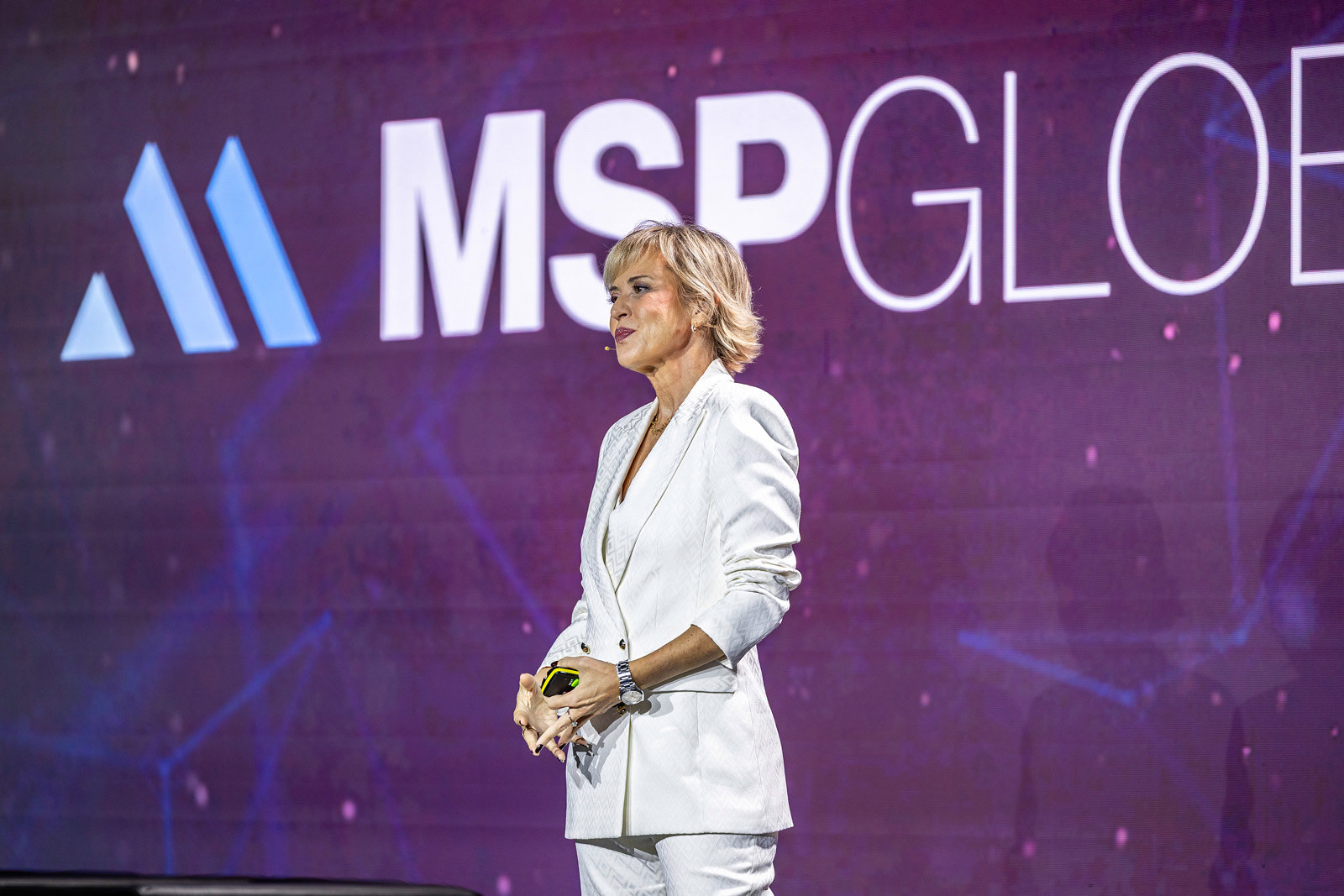
Our leading piece of video content right now is Carme Artigas’s 2025 session on the EU AI Act (pictured above). As Spain’s former Secretary of State for Digitalization and AI, Carme led the negotiations that shaped the Act, so this isn’t commentary on the law; it’s insight from one of the people who helped write it. The session has attracted 4,438 views so far (a big number in the MSP world, even if Mr. Beast wouldn’t notice), and I hope this post sends it plenty more:
Why has that one video done so well? It’s original, it comes from a genuine expert, and it meets a real audience need, because every MSP with European clients needs to understand the EU AI Act. That’s exactly the sort of content (and data) AI can’t generate, and GEO will value.
The MSPs winning at content marketing aren’t the ones with the biggest budgets. They’re the ones willing to open the books on what they’ve actually seen, fixed, and learned.
Q&A: Content marketing for MSPs
Generative engine optimization (GEO) is the practice of making content easy for AI tools such as Google AI Mode, ChatGPT, and Perplexity to find, trust, and cite in their answers. SEO aims for a ranking and a click; GEO aims for a citation or a mention. GEO is also known as AEO (Answer Engine Optimization), LLMO (Large Language Model Optimization), and AISO (AI Search Optimization).
Not for being AI-generated in and of itself. Google judges content on quality and helpfulness, not how it was produced, but mass-produced, low-value pages can be treated as spam. A human-edited piece with original insight and a named author is the safe ground.
Article 50 requires disclosure of AI-generated text published to inform the public on matters of public interest, with an exemption for text that has had human review and sits under editorial responsibility. Most edited, signed MSP blogs will fall on the right side of that line, but check with your own legal advisor. For background, Carme Artigas’s session is hard to beat. (Hey, that’s one more view for the video!)
Publish content AI can’t produce on its own: aggregated benchmarks from your ticket data, anonymized incident post-mortems, patch response times, client before/after outcomes, and honest tool reviews. Add a named author, a method note, and Q&As built around your buyers’ real questions.
Regularly ask AI engines the questions your prospects ask, and record whether your brand is mentioned or cited. Track that alongside branded search volume and the quality of inbound leads, not just website sessions.
Swap notes with the MSPs doing it well
MSP GLOBAL brings together thousands of MSPs, vendors, and Cloud providers from across Europe and beyond, with dedicated sales and marketing sessions alongside the security and operations tracks. Join us October 20–21, 2027, at PortAventura Theme Park, Barcelona, and bring your best (anonymized) data. Someone in the room will want to compare notes. Get your free registration code.
How this post was made: this blog was shaped with the help of Claude, together with hours of editorial input from the author, who has decades of content marketing experience. The concept and detailed brief came from the author, then the structure and research were developed with AI before a joint effort on the writing and editing process; the opinions, the MSP GLOBAL examples, and the final say are human.