The SaaS business model has been one of the great success stories of the Cloud era. Software moved from something businesses bought, installed, and periodically upgraded to something they subscribed to continuously. Vendors gained predictable recurring revenue; customers gained flexibility; and MSPs built increasingly sophisticated services around managing a growing stack of Cloud applications.
Now that model is being questioned.
The term “SaaSpocalypse” has emerged to describe a wave of concern that AI could fundamentally disrupt the economics of software-as-a-service. It is not a prediction that SaaS is about to disappear. Rather, it describes the realization that some software products may no longer be as defensible, valuable, or indispensable as was once assumed. In early 2026, around $300 billion was wiped from the valuations of some software companies as investors reassessed how AI could change the software market.
For MSPs, the impact goes well beyond the stock market. If the software landscape is changing, the role of the organization that helps customers select, integrate, secure, and manage that software changes with it.
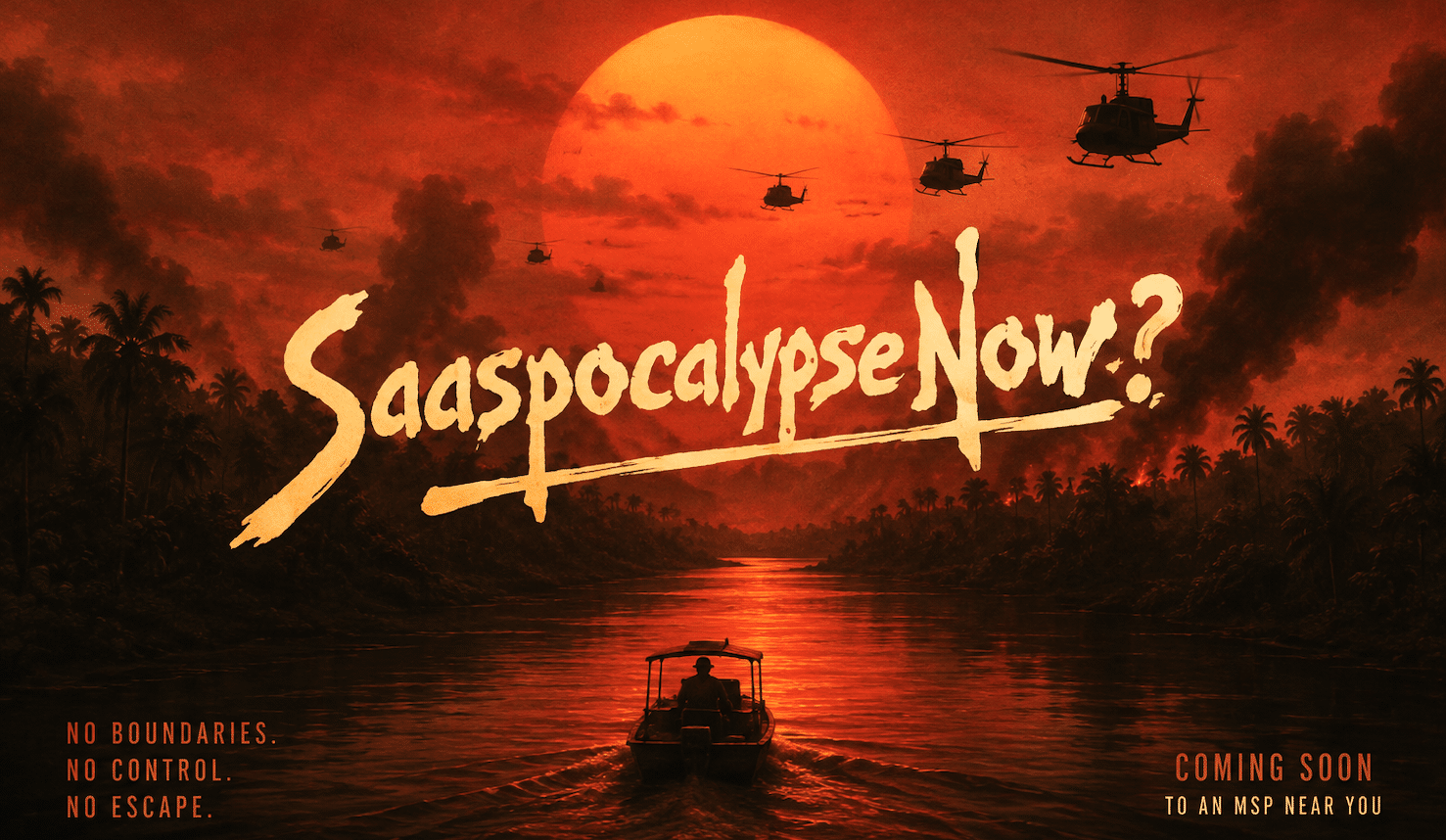
Having discussed agentic arbitrage in a previous article, let’s jump aboard a Huey and take a trip into the heart of darkness to discover if MSPs should really fear Saaspocolypse Now…
The SaaS moat is being tested
The traditional SaaS proposition has relied on more than just useful features. Software companies have built substantial competitive moats through proprietary technology, embedded workflows, valuable data, customer relationships, network effects and, importantly, the high cost and inconvenience of switching platforms.
AI challenges some of those defenses. If a business can accomplish a task through a general-purpose AI system, a lightweight application, or a customized workflow without buying another dedicated platform, the application’s value can come under pressure.
Law firm Pinsent Masons highlights the distinction particularly well, noting that workflow-oriented SaaS products may be more exposed because their value is concentrated in the user interface and process coordination layers. Those are precisely the areas that AI can increasingly reproduce or abstract away. At the same time, software embedded in highly regulated, customized, and business-critical processes is harder to displace because governance, auditability, integration, and switching costs remain important.
That distinction is crucial for MSPs. The question is no longer, “Which SaaS products should we sell and manage?” It becomes, “Which technology remains strategically valuable to this customer, and what is the best way to deliver the required business outcome?”
The MSP’s opportunity is not to defend SaaS
This is where the SaaSpocalypse becomes an MSP story rather than merely a software-industry story.
An MSP does not have to defend the economics of a particular application. Its value comes from helping customers make technology work. If a client needs a CRM, collaboration platform, security product or business application, the MSP can recommend one. If that category changes, the MSP can recommend something else, including an AI agent.
That creates an important advantage in a market where technology is becoming less predictable.
Epic IT makes a similar argument in its analysis of the SaaSpocalypse, suggesting that MSPs are relatively well positioned to become the layer of continuity between the customer and an increasingly fluid technology environment.
That means MSPs should resist the temptation to view SaaS disruption simply as an opportunity to replace licenses with the latest AI tool. The bigger opportunity is to become the organization that continually rationalizes the customer’s technology estate: identifying what remains essential, what has become redundant, where capabilities can be consolidated, and where new tools genuinely create business value.
The next battleground is technology rationalization
For many customers, the SaaSpocalypse will not arrive as a dramatic decision to abandon SaaS. It will show up as a series of smaller questions.
Why are we paying for three tools that perform similar functions? Does every employee still need these licenses? Could a workflow be handled more efficiently without another application? Are we paying for features nobody uses? Is an application becoming less valuable as AI capabilities are built elsewhere? And also, potentially: what happens when we have to roll back to a SaaS we thought we didn’t need anymore?
These questions create a new service opportunity for MSPs: technology rationalization.
The MSP that can map a customer’s application estate, understand how each system is actually used, identify overlapping capabilities, and recommend a future-state architecture can create value even when the answer is to reduce software spend. That is a significant shift from the traditional channel economics of adding another subscription to the stack.
It also strengthens the MSP’s strategic position. Customers are likely to need more help managing technology precisely because there are more choices and fewer assumptions about which products will remain dominant.
Don’t mistake the SaaSpocalypse for the end of SaaS
There is an important counterpoint that we hinted at above: the apocalypse may be overstated. Hey, it’s not the end of the world…
Pinsent Masons notes that investors may have overestimated the productivity gains from AI and therefore overestimated the threat to software. Major enterprise software companies continue to report strong growth, while businesses still depend heavily on applications that provide governance, integration, compliance and systems of record.
Recent market developments reinforce that caution. Analysts suggest that software sentiment had begun shifting from fear toward opportunity, following stronger-than-expected results from companies including Salesforce.
So don’t call the coroner just yet: MSPs should not respond by assuming that SaaS is dead. They should respond by assuming that SaaS is changing.
The winners may be different. Pricing models may evolve. Applications may become more modular. Interfaces may matter less than the data and business processes underneath them. Customers may consolidate their application estates rather than continually adding to them.
For MSPs, that is potentially good news.
The MSP that remains neutral about individual vendors, understands the customer’s business processes, and can continuously adapt the technology environment has a role whatever happens to the SaaS market.
The SaaSpocalypse, in other words, is not necessarily a threat to managed services. It reminds us why managed services exist in the first place: customers don’t ultimately want software. They want technology that works.
Join us at MSP GLOBAL in Spain, October 21-22, for the latest insight on how MSP business models are changing. Plus free beer and server throwing! Scroll down and subscribe for €0 registration.
SaaSpocalypse: MSP questions answered
What is the SaaSpocalypse?
The SaaSpocalypse is a term describing concerns that AI could disrupt traditional SaaS business models by making some software capabilities easier to reproduce, replace, or consolidate. It has also been used to describe the resulting volatility in software-company valuations.
Does the SaaSpocalypse mean SaaS is dying?
No. SaaS remains fundamental to business technology, particularly where applications provide complex integration, governance, compliance, data and business-critical functionality. The more likely outcome is a significant evolution in how SaaS products are built, priced and consumed.
Why should MSPs care about the SaaSpocalypse?
Because changes to the SaaS market will change the technology environments MSPs manage. Customers will need help deciding which applications to retain, consolidate, replace, or integrate, creating opportunities for MSPs to provide more strategic technology guidance.
Should MSPs stop selling SaaS?
Definitely not! The smarter response is to become less dependent on selling individual applications and more focused on delivering business outcomes. SaaS will remain important, but the MSP’s value should come from helping customers build and operate the right technology environment.
What is the biggest SaaSpocalypse opportunity for MSPs?
Technology rationalization. MSPs can help customers understand their application estate, eliminate unnecessary duplication, manage change, and select the technologies that remain strategically valuable as AI reshapes the software market.
What should MSPs do now?
Start by reviewing the SaaS environments they already manage. Identify applications that are heavily dependent on user interfaces or simple workflows, assess overlapping functionality, understand where customers have genuine switching costs, and build a clear view of where emerging technologies could change the economics. The objective is not to predict which software companies will survive. It is to ensure the MSP remains valuable, whichever ones do
Image created with AI, with acknowledgment and respect to Francis Ford Coppola and American Zoetrope