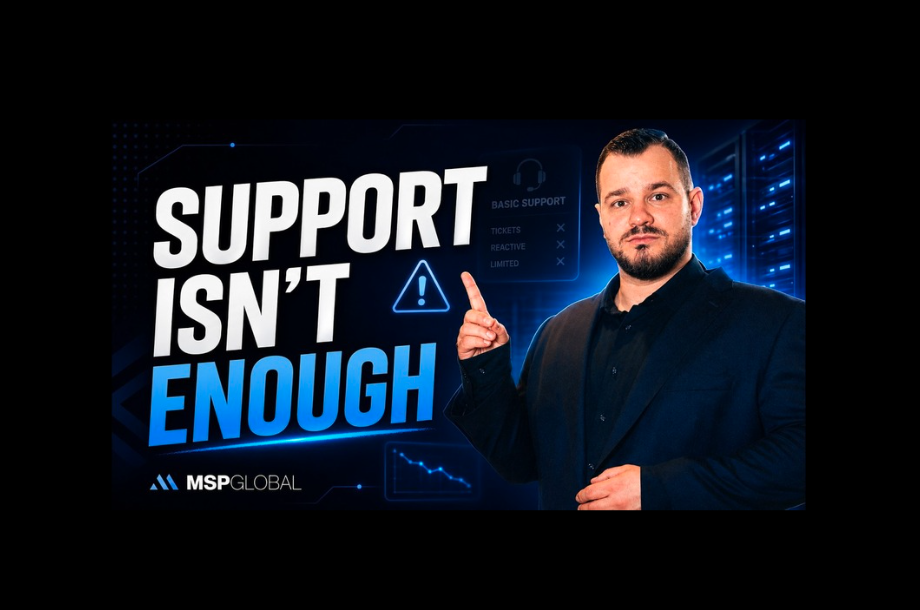
The old MSP model is breaking. Here’s what replaces it.
For years, Managed Service Providers built successful businesses around a straightforward promise: keep IT systems running smoothly, respond quickly to issues, and maintain a secure, reliable technology environment.
That model still matters; but according to Georgij Boguslawskij, founder of Seraph IT, it is no longer enough.
On MSP GLOBAL’s YouTube channel, Georgij argues that many MSPs face a bigger threat than AI: becoming indistinguishable from their competitors. When every provider talks about cybersecurity, Microsoft 365, backups, proactive support, and Cloud services, clients struggle to see meaningful differences. The result is that buying decisions increasingly come down to price.
Watch the full video here:
Georgij believes the next generation of successful MSPs will move beyond traditional support services and position themselves as trusted advisors who help clients navigate complexity, risk, governance, compliance, and AI adoption.
Here are six key takeaways:
Sameness is a bigger threat than AI
While AI dominates industry headlines, Georgij argues that many MSPs face a more immediate challenge: they all sound the same.
From a prospect’s perspective, MSP websites often use identical language around managed services, cybersecurity, Cloud solutions, backups, and support. When buyers cannot identify meaningful differences between providers, they default to comparing costs.
This creates a race to the bottom that few MSPs can win.
Instead, MSPs must reset their marketing efforts at a fundamental level, which starts with developing a clearer position in the market and communicating a distinctive value proposition that resonates with customer needs.
IT support is now just the foundation
Today’s MSPs operate in a far more complex environment than they did five years ago. Clients still need tickets resolved, users onboarded, backups tested, endpoints protected, and Microsoft 365 environments managed. TBut these services have all become baseline expectations. Now service providers are managing Cloud platforms, SaaS applications, remote workforces, cyber insurance requirements, customer data, compliance obligations, and increasingly, AI tools.
As Georgij explains, the MSP’s role is evolving from technology operator to complexity manager.
Instead of asking, “Can we support the client?”, , MSPs should be thinking: “What business complexity are we helping clients manage?”
AI governance is a major MSP opportunity
Many customers are already experimenting with AI and want guidance.
The easy response is to recommend a tool. The more valuable response is to help clients implement AI responsibly.
Questions around data access, permissions, information governance, security controls, compliance obligations, and acceptable use policies quickly emerge as organizations scale AI adoption. This creates a significant advisory opportunity for MSPs.
Customers do not need more AI hype, and they may not even need the shiniest new tool. They need practical guidance that helps them understand risks, establish guardrails, and make informed decisions.
The MSPs that provide that guidance can become indispensable strategic partners.
SaaS sprawl is becoming a business risk
Few organizations deliberately create complexity. Instead, it accumulates gradually. You know how it goes: a project management platform here. A CRM add-on there. An AI assistant, browser extension, collaboration tool, reporting platform, or file-sharing service.
Over time, businesses lose visibility into where data resides, who has access, which licenses remain active, and how different systems interact.
For MSPs, SaaS governance presents a growing opportunity. Helping customers regain visibility and control over their technology estate can deliver significant business value while reducing operational and security risks.
MSPs must make value visible
One of Georgij’s strongest messages is that many MSPs struggle to demonstrate the outcomes they create. Adding more tools, dashboards, and reports does not automatically increase perceived value.
Clients want answers to simple questions:
- What risks have been reduced?
- What incidents have been prevented?
- What decisions have become easier?
- What business outcomes have improved?
Technical excellence alone is no longer enough. Successful MSPs will increasingly focus on translating technical work into measurable business impact that customers can clearly understand.
The future belongs to specialists, not generalists
“Sell outcomes, not tools” has become a popular industry phrase, but Georgij argues that MSPs need to go further. Rather than trying to be everything to everyone, providers should consider building expertise around specific customer challenges.
Examples include:
- Compliance and security readiness for regulated organizations
- Identity management and cyber insurance preparation
- AI governance and adoption frameworks
- Business continuity and resilience planning
- SaaS governance and risk management
When MSPs become known for solving a specific business problem, they become significantly harder to replace.
The MSP model is evolving—not disappearing
The traditional MSP model is not dead. Support, monitoring, backups, security, and operational excellence remain essential—but they are increasingly expected rather than valued as differentiators.
The MSPs best positioned for future growth will be those that help customers make better technology decisions before problems become crises. They will translate risk into business language, make security visible, provide evidence of value, and help organizations navigate increasingly complex technology environments.
Most importantly, they will stand for something more specific than the plain ol’ vanilla “We manage IT.”
Join the conversation at MSP GLOBAL
The future of the MSP industry will not be defined by tools alone. It will be shaped by new business models, evolving customer expectations, AI adoption, cybersecurity challenges, and the changing role of trusted advisors.
If you want to stay ahead of these trends, join industry leaders, innovators, and MSP experts at MSP GLOBAL in Spain, October 21-22.
Subscribe to the MSP GLOBAL newsletter (below) to receive the latest industry insights, speaker announcements, and a free registration code for MSP GLOBAL 2026.
The next chapter of the MSP industry is already taking shape. Make sure you’re part of the conversation.