
NIS2, the AI Act, supplier risk, incident reporting, shadow AI—none of this is exactly bedtime reading. But for MSPs, this is all quickly becoming a core part of the job. As we explored in the MSP GLOBAL 2025 Expert Stage preview, compliance is no longer just red tape or a legal department problem. Done properly, it becomes a trust engine, a resilience strategy, and yes, a business advantage. Done badly, it becomes the thing everyone wishes they had taken seriously before the 24-hour reporting clock started ticking.
That is why we spoke with Michael Bartsch, CEO of Deutor Cyber Security Solutions GmbH, whose view is refreshingly direct: NIS2 is not a “firewall regulation.” It is a management, governance, and supply chain reality check. Following our recent conversation with Dr. Stefanie Frey on why MSPs are becoming strategic cybercrime targets, and the wider CloudFest discussion around enterprise IT becoming a business discipline, Bartsch brings the topic down to earth: what MSPs should document, what they should demand from suppliers, how AI tools enter the risk register, and what a realistic 90-day “NIS2/AI Ready” package could actually look like.

NIS2 is often described as a cybersecurity regulation, but for many companies it is really a management and supply-chain issue. How should MSPs explain this shift to their customers?

MSPs must make one thing clear to their customers: NIS2 is not simply a “firewall regulation”. It is an organizational standard, and it needs to be understood first and foremost through the lens of liability. If management, including C-level executives, chooses to ignore NIS2 requirements, they may be held personally accountable.
The real focus is supply chain resilience. A company may believe it has built an internal “Fort Knox”, but if the MSP’s maintenance access is compromised, or if an insecure software tool becomes the weak link, the entire structure can collapse. This is why MSPs need to position themselves not only as technology providers, but as risk managers. They are no longer just selling licenses; they are helping customers protect compliance, security, and business continuity.
Where do you see companies struggling most with NIS2 implementation: governance, documentation, incident response, supplier control, or technical measures?
The biggest hurdle currently isn’t the technology, but governance and documentation. Many SMEs already have processes in place, but they are often informal and undocumented. Under NIS2, “we’ve always done it this way” is no longer enough; companies need to be able to demonstrate what they do, who is responsible, and how decisions are made.
Supplier control is another major pain point. Auditing third-party providers can be extremely difficult, especially because many companies do not even have a clear picture of who has access to their data, systems, or infrastructure. On top of that, incident response remains a serious challenge. The 24-hour deadline for initial reporting is simply unrealistic for many SMEs unless they have a SOC connection or another structured way to detect, assess, and escalate incidents quickly.
For MSPs and IT service providers, how does NIS2 change the relationship with customers and subcontractors?
NIS2 turns the MSP into a part of the customer’s critical infrastructure. This means customers will, and must, demand proof that their MSPs operate according to recognized security and compliance standards, such as ISO 27001, SOC 2, or ISAE 3402.
At the same time, MSPs cannot look only at their own internal processes. They also need to ensure that their subcontractors, including cloud providers and tool manufacturers, act in compliance with NIS2 requirements. In this sense, the MSP becomes the gatekeeper of security, responsible not only for its own services but also for the resilience of the broader supply chain.
What should a realistic supplier risk assessment look like under NIS2—especially for companies with limited internal cybersecurity resources?
An SME cannot conduct 50-page audits for every supplier. A realistic approach starts with classification: suppliers should be grouped according to their importance, from A suppliers that are critical for operations, to B suppliers that are important, and C suppliers that have little or no impact on business continuity.
From there, companies can use standardized self-assessment questionnaires, for example based on frameworks such as the NIST CSF or CIS Controls, instead of reinventing the process each time. They should also manage certificates and formal proof in a structured way, requesting updated evidence annually. Finally, cyber-security clauses need to become standard in every supplier contract, so that security expectations are not only discussed, but formally agreed and enforceable.
How does the AI Act add another layer of responsibility to the digital supply chain, particularly when companies use third-party AI tools or integrate AI into services? Where do NIS2 and the AI Act overlap from a practical risk-management perspective?
The AI Act does not regulate AI itself, but the risk of its application. For MSPs, this means looking closely at how AI tools are used in practice and what happens to the data that passes through them. If tools such as Copilot or DeepL are used, the key questions become very concrete: where does the data go, who can access it, and is it used for training?
This also creates a new version of an old problem: shadow AI. Just as MSPs have had to manage shadow IT, they now need to prevent employees from uploading sensitive customer data into unlicensed or uncontrolled AI models. The overlap with NIS2 is clear, because both frameworks are built around risk management. If an AI system is used to make critical decisions, for example in logistics or medicine, it may become both a critical asset under NIS2 and a high-risk system under the AI Act.
Should MSPs treat AI tools as part of their critical supply chain, even when those tools are used only internally for productivity or automation?
Definitely, yes. Even if an AI only writes emails, it still needs to be assessed in terms of risk and operational impact. The level of criticality increases significantly when AI is used to automate IT processes, for example by generating patch management scripts or supporting technical workflows that affect customer systems.
For this reason, an MSP should include every AI tool in its asset register and evaluate what could happen if the tool fails, produces incorrect output, or generates a “hallucination.” The key question is not whether the AI looks simple on the surface, but whether an error in its use could disrupt operations, compromise data, or create a compliance risk.
What contractual or operational safeguards should MSPs start putting in place with software vendors, cloud providers, and AI service providers?
What you should include in contracts with software and cloud providers now is a clear framework for accountability, reporting, and liability. The right to audit should be formally addressed, even if in practice you cannot audit Big Tech companies directly. In those cases, the contract should at least refer to their compliance reports, certifications, and available assurance documentation.
Incident notification SLAs are equally important. Providers should be required to notify you of relevant security incidents within 12 to 24 hours, so that you still have enough time to meet your own 24-hour reporting obligations toward the customer. Finally, MSPs need to review liability caps carefully and make sure their exposure for third-party failures is appropriately limited. Otherwise, they may end up carrying risks that are outside their direct control.
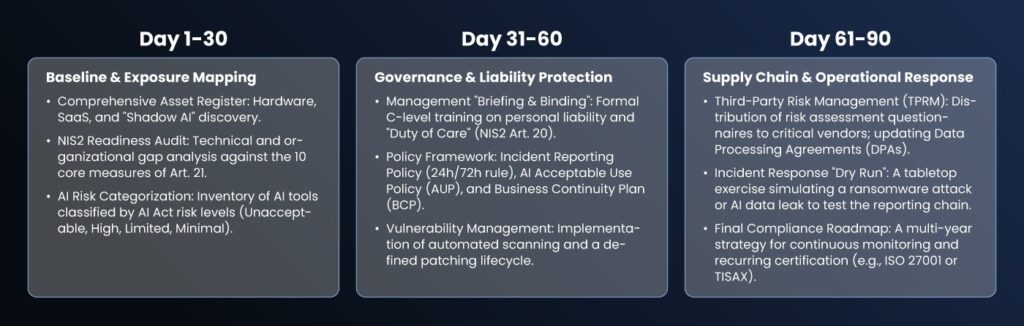
If an MSP wants to turn NIS2 and AI Act readiness into a clear service offering, what should be included in the first 90 days of work with a client?
If you are creating a new service offering, the roadmap should look like this.
[For clarity, and to turn the discussion into a practical framework, we developed the chart below together with Michael’s input. This may be faster than reading 5,000 more words!]
See Michael Bartsch at MSP GLOBAL 2026
Michael Bartsch will join the MSP GLOBAL 2026 speaker lineup in PortAventura, Spain, where the MSP community will gather to talk cybersecurity, business growth, service delivery, partnerships, and the future of managed services.
His message is clear: “NIS2 is not a firewall regulation. It is a management, governance, and supply chain reality check.“